
Beck’s Chimney Sweep: Providing Expert Chimney Repair Services in Sheridan, IN
Sheridan, IN is a place where community values and well-maintained homes go hand in hand, and at Beck’s Chimney Sweep, we are honored to be the first choice for residents looking to keep their hearths in peak condition. Whether you are living in a historic farmhouse on the edge of town or a newer build closer to the center of the village, your chimney is a vital component of your home’s structural integrity and venting performance. Over time, exposure to Indiana’s fluctuating weather can cause masonry to crack, liners to deteriorate, and water to find its way into your living space.
Our team focuses on providing high-quality chimney repair services that help you maintain the beauty and functionality of your fireplace. We don’t just patch up problems. We look for the root cause of the issue to ensure that our solutions are as durable as possible. From crown reconstruction to tuckpointing, our craftsmen bring a level of detail that protects your home and keeps your fireplace venting as efficiently as possible during those cold Midwestern winters.
What Causes a Chimney to Lean Away From the House?
A leaning chimney or the presence of deep vertical cracks is often a sign of significant structural distress that goes beyond simple cosmetic wear. When we visit homes in Sheridan, we often find that these issues stem from the foundation. Because chimneys are incredibly heavy masonry structures, they require a robust, reinforced concrete footing. If that footing was poured too thin, is resting on unstable soil, or has been compromised by poor drainage, the chimney may begin to tilt.
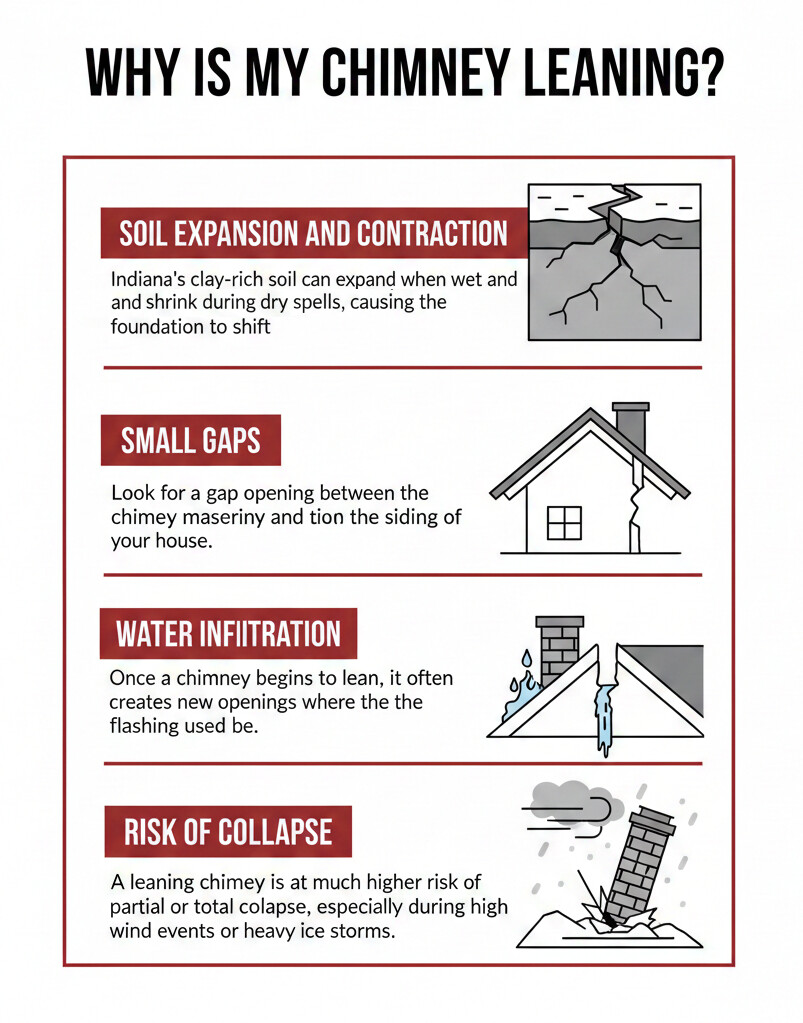
- Soil Expansion and Contraction: Indiana’s clay-rich soil can expand when wet and shrink during dry spells, causing the foundation to shift.
- Early Warning Signs: Look for a gap opening between the chimney masonry and the siding of your house. Even a small “hairline” gap at the top can indicate the structure is beginning to pull away.
- Water Infiltration: Once a chimney begins to lean, it often creates new openings where the flashing used to be. This allows rainwater to pour directly into your attic and walls.
- Risk of Collapse: A leaning chimney is at a much higher risk of partial or total collapse, especially during high wind events or heavy ice storms.
Our approach to these repairs involves a thorough assessment of the chimney’s base. If the tilt is caught early, we can often implement stabilization techniques. However, if the masonry has already begun to fracture due to the stress of the lean, we may need to perform a partial or full rebuild to ensure the structure remains as stable as possible. We prioritize your home’s integrity, ensuring that the heavy masonry is properly supported so you don’t have to worry about the safety of your family or your property.
Your Trusted Sheridan, IN Chimney Professionals: Serving A Historic Community
Sheridan is a town that prides itself on its rich heritage and its “small-town” charm. Located in the northwestern corner of Hamilton County, it offers a peaceful retreat from the hustle and bustle of the larger neighboring cities. Residents here enjoy a close-knit atmosphere where neighbors truly know one another, and local traditions—like the various events held at Biddle Memorial Park—are the heartbeat of the community.
The park itself is a local treasure, offering sprawling green spaces, walking trails, and playgrounds that make it a favorite spot for families to gather. History buffs also appreciate the Sheridan Historical Society Museum, which preserves the legacy of the town’s development and its agricultural roots. Because Sheridan features many older, beautifully preserved homes, our chimney repair services are frequently called upon to restore vintage masonry that has stood for decades. We love working in this area because the homeowners here understand the value of preservation and the importance of keeping their classic fireplaces working as reliably as possible.
Is It Okay To Skip an Annual Inspection If I Rarely Use My Fireplace?
A common misconception among Sheridan homeowners is that if they don’t light a fire, their chimney doesn’t need attention. In reality, a chimney that sits dormant can often face more “hidden” threats than one used regularly. Chimneys are the most exposed part of your home, and they are working 24/7 to keep the elements out of your house, whether a fire is burning or not.
- Animal Intrusions: During the spring and summer, unused chimneys are prime real estate for chimney swifts, raccoons, and squirrels. Their nests can completely block a flue, creating a major fire hazard the next time you do decide to use it.
- Water Damage: Small leaks in the flashing or cracks in the chimney crown don’t care how often you use your fireplace. Water will seep in, rot your floorboards, and rust your firebox regardless of your burning habits.
- Freeze-Thaw Deterioration: As we discussed, Indiana’s winter cycles cause water trapped in masonry to expand and contract. This happens to every chimney in town, and an inspection can catch this “spalling” before it requires a full rebuild.
- Debris Accumulation: Over time, leaves and twigs can fall into the flue, or the clay liner itself may begin to flake off (delaminate) due to age.
Skipping inspections often leads to “surprise” repairs that are much more expensive than routine maintenance. By having us out once a year, we can ensure that your chimney remains as weather-tight as possible, saving you money in the long run and ensuring that when you finally do want that cozy Christmas fire, your system is ready to perform.
Do Gas Fireplaces Need Regular Chimney Inspections?
Many people in Sheridan have switched to gas logs or inserts for the convenience they provide. While gas is a “cleaner” fuel in terms of creosote, it is by no means maintenance-free. In some ways, a malfunctioning gas venting system can be even more dangerous because the threats are invisible and odorless.
- The Carbon Monoxide Risk: If a gas flue is blocked by a bird’s nest or a collapsed liner, carbon monoxide can back up into your home. Unlike wood smoke, you can’t see or smell it, making a clear venting path vital.
- Acidic Condensation: Gas appliances produce a significant amount of water vapor during combustion. This vapor is slightly acidic and can eat away at the mortar joints of a masonry chimney much faster than wood smoke.
- Debris and Dust: Dust and pet hair can clog the burner ports of a gas fireplace, leading to an uneven flame and incomplete combustion, which produces more soot and carbon monoxide.
- Spider Webs in the Pilot: It sounds minor, but small spiders are attracted to the smell of the mercaptan in gas. They often spin webs in the pilot or burner tubes, which can prevent the unit from lighting or cause it to “pop” dangerously.
Our team doesn’t just look at the masonry; we check the entire venting system of your gas unit. We ensure the glass is sealed correctly, the logs are positioned for the best airflow, and the flue is as clear as possible to vent those invisible gases safely out of your home.
How Do Different Seasons Contribute to Chimney Blockages?
In a town like Sheridan, each season brings a new challenge to the health of your chimney. Understanding these seasonal cycles helps us explain why a repair might be necessary even if the fireplace was working fine just a few months ago.
- Spring: This is “nesting season.” Without a proper chimney cap, your flue is a giant hollow tree for local wildlife. Additionally, spring rains often reveal the first signs of a leaky chimney through water stains on your ceiling.
- Summer: High humidity can react with the soot and creosote left over from winter, creating a strong, “charcoal” odor that drifts into your house. This is often when we perform deep cleanings and deodorizing repairs.
- Fall: Falling leaves are a major culprit for clogged gutters and, by extension, clogged chimneys. If your house is surrounded by the beautiful mature trees Sheridan is known for, your chimney crown and cap need to be cleared of organic debris that holds moisture against the brick.
- Winter: This is when “stack effect” is at its strongest. Your home acts like a vacuum, pulling air in through the basement and pushing it out through the attic and chimney. If your chimney has cracks or gaps, this pressure can pull cold air (and moisture) into the structure, accelerating decay.
By keeping an eye on these seasonal changes, we can perform targeted repairs that address the specific stressors your chimney is facing at that time of year. Whether it’s clearing a spring nest or sealing a winter crack, our goal is to keep your system functioning as smoothly as possible.
What Happens If You Light a Fire When the Flue Is Still Damp After Heavy Rain?
After a long Indiana downpour, it might be tempting to light a fire to “dry things out.” However, if your chimney has structural issues that allow water to saturate the internal masonry, lighting a fire can actually cause immediate and significant damage through a process known as “spalling.”
- Steam Pressure: When the 500-degree heat of a fire hits water-saturated bricks or mortar, that water turns to steam instantly. Steam expands rapidly, and if it’s trapped inside the pores of the brick, it can blow the face of the brick right off.
- Mortar Washout: If your chimney crown is cracked, water can sit in the “middle” of your chimney wall. A fire can cause this trapped water to boil, effectively “cooking” the mortar from the inside and turning it into a sandy powder that no longer supports the bricks.
- Creosote Liquefaction: Water can turn solid creosote into a liquid, acidic “sludge” that runs down the inside of your flue and leaks out of the cleanout door or onto your hearth, staining your carpet and creating a permanent odor.
If you suspect your chimney is taking on water, the best course of action is to have us perform a leak investigation. We can find the entry point—whether it’s the flashing, the masonry, or a faulty cap—and repair it so that your flue stays dry and ready for use.
Can a Gas Fireplace Be Repaired or Does It Need To Be Replaced?
The good news is that most gas fireplace problems don’t require a full replacement. Faulty thermocouples, malfunctioning ignition systems, worn gas valves, clogged burner ports — these are everyday fixes that our CSIA-certified technicians at Beck’s Chimney Sweep handle regularly. A proper diagnosis often reveals that what seems like a major failure is actually a straightforward repair.
That said, there are situations where replacement makes more sense. Extensive corrosion, cracked fireboxes, and discontinued parts can make ongoing repairs impractical. If your unit is over 20 years old and breaking down frequently, upgrading to a modern, energy-efficient model could save you money over time rather than sinking more into a declining system.
The only way to know for sure is through a thorough professional evaluation. Our team at Beck’s will give you an honest assessment — if a repair will solve the problem, that’s what we’ll recommend. We don’t push replacements when they aren’t warranted.
Contact Beck’s Chimney Sweep For Your Sheridan, IN Chimney Repairs
Don’t let a small crack in your masonry or a minor leak turn into an expensive structural failure. At Beck’s Chimney Sweep, we are dedicated to helping Sheridan homeowners maintain chimneys that are as durable and reliable as possible. From historic restorations to modern venting solutions, our team has the expertise you can trust for all of your chimney repair services.